
Gilsonite Chemical Composition and Structure

To use gilsonite well, it helps to know what it is made of. Gilsonite is a complex natural hydrocarbon, but its composition can be described in a few simple terms.
Elemental analysis
Typical values for commercial gilsonite are:
- Carbon: 75–85%
- Hydrogen: 8–10%
- Nitrogen: 0.5–3%
- Sulfur: 0.3–4%
- Oxygen: 0.5–4%
The relatively high nitrogen content is characteristic of natural asphalts and contributes to their excellent adhesion.
Molecular families
Gilsonite consists mainly of asphaltenes and resins, with only small amounts of oils. Many molecules contain polar groups (nitrogen, sulfur and oxygen), known as NSO compounds, together with saturated and aromatic hydrocarbon chains. These polar groups help gilsonite stick to mineral surfaces, pigments and steel.
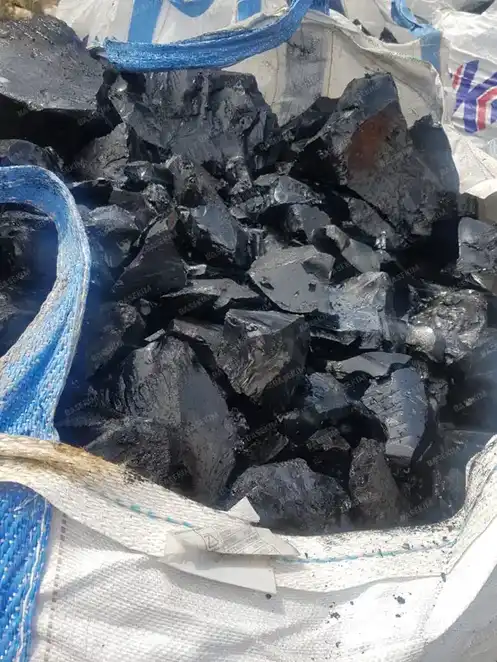
Ash and impurities
Ash is the non-combustible mineral matter left after burning. High-quality gilsonite has low ash, typically below 5%, and very low moisture (below 1%). Low ash is important for inks, paints and drilling fluids, where mineral particles could cause abrasion or affect performance. Read more in why ash content matters in gilsonite.
Volatile matter
When heated without air, gilsonite releases 55–75% volatile matter. This property is useful in foundry sand, where gas release during casting creates a clean mould–metal interface.
Solubility
Gilsonite is almost completely soluble in toluene, trichloroethylene and carbon disulfide, and it blends easily with bitumen and many oils. It is insoluble in water, alcohols and acetone, which explains its water and chemical resistance.
What it means for users
This composition gives gilsonite its key properties: high softening point, strong adhesion, deep black colour, low density and chemical resistance. All Sun Gilsonite grades, including our gilsonite powder, are supplied with a COA showing the critical values.
Recommended product
Gilsonite Powder
| Property | Typical value | Test method |
|---|---|---|
| Appearance | Black to dark brown powder | Visual |
| Particle size | 100 – 200 mesh | Sieve |
| Softening point (R&B) | 150 – 220 °C | ASTM D36 |
| Ash content, max | 5 % | ASTM D3174 |
| Moisture, max | 1 % | ASTM D95 |
| Volatile matter | 55 – 75 % | ASTM D3175 |
| Solubility in toluene, min | 99 % | ASTM D2042 |
| Specific gravity @ 25°C | 1.04 – 1.10 | ASTM D70 |
| Typical dosage | Drilling 2–8 lb/bbl · asphalt 4–12 % of binder · foundry 0.3–1.0 % | |
| Packing | 25 kg multi-wall paper or PP bags, palletized and stretch-wrapped; 1 MT jumbo bags. | |
Typical values. The final specification is confirmed in the COA of each shipment.
Related articles
How Gilsonite Is Mined and Processed
Gilsonite occurs in narrow vertical veins that cut through surrounding rock. These veins can be a few centimetres…

Gilsonite Packing Options for Export
How gilsonite is packed affects cost, handling and product protection. These are the most common options. The standard…

Shipping Gilsonite by Container and Truck
Gilsonite is shipped around the world by sea container, flatbed truck and bulk vessel. Good logistics planning saves…