
Gilsonite in Oil Well Cementing

Gilsonite has been used in oil well cement slurries for decades. Its low density and sealing ability make it a valuable additive for weak formations and gas wells.
Benefits
- Lower slurry density without much loss of compressive strength
- Lost circulation control while cementing
- Improved bonding to casing and formation
- Gas migration control
- Increased elasticity of set cement, reducing cracking from thermal and pressure cycles
How it works
Gilsonite particles are lighter than cement (specific gravity about 1.05) and act as a lightweight extender. They also bridge across fractures and seal them during placement.
Typical dosage
5–15% by weight of cement, adjusted to target density and well conditions.
Particle size
100–200 mesh gilsonite mixes well and stays suspended in the slurry.
Testing
Run thickening time, compressive strength, fluid loss and free water tests with the actual blend.
Typical slurry design data
| Parameter | Example target |
|---|---|
| Slurry density | 12.5–14 ppg |
| Gilsonite | 5–15 % BWOC |
| Thickening time | Matched to job time |
| Compressive strength | Meets well requirements |
Field mixing
Dry-blend gilsonite with cement at the bulk plant. Avoid adding loose gilsonite at the mixer, which can cause uneven slurry.
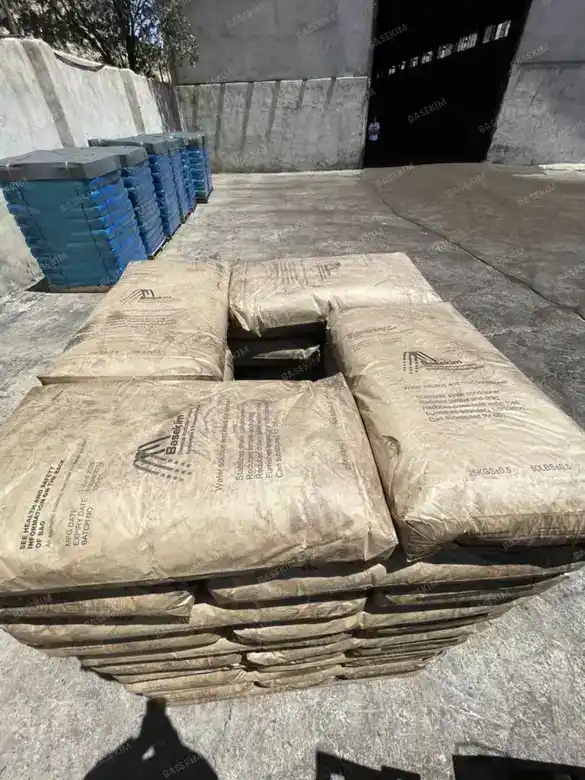
Our cementing grade gilsonite is supplied in 25 kg bags and jumbo bags. Read lightweight cement slurries with gilsonite.
Recommended product
Cementing Grade Gilsonite
| Property | Typical value | Test method |
|---|---|---|
| Appearance | Black solid, shiny | Visual |
| Softening point (R&B) | 160 – 220 °C | ASTM D36 |
| Ash content | 3 – 8 % | ASTM D3174 |
| Solubility in TCE | 95 – 99 % | ASTM D2042 |
| Specific gravity @ 25°C | 1.04 – 1.06 | ASTM D70 |
| Moisture, max | 1 % | ASTM D95 |
| Particle size | 75 – 200 µm | Sieve |
| Typical dosage | 5 – 15 % BWOC | |
| Packing | 25 kg bags palletized; 1 MT jumbo bags. | |
Typical values. The final specification is confirmed in the COA of each shipment.
Related articles
Testing Gilsonite in the Mud Laboratory
Before a field trial, laboratory testing confirms that a gilsonite grade suits your fluid and well conditions. Confirm…
Sulphonated Asphalt vs. Gilsonite: Which Suits Your Mud?
Both sulphonated asphalt and gilsonite are asphaltic shale stabilizers, but they behave differently in drilling fluids. Natural, hard…
Gilsonite in Drilling Fluids Explained
Drilling fluid, or "mud", does many jobs: it carries cuttings to the surface, cools the bit, balances formation…