
Ink–Water Balance in Offset Printing and Gilsonite
In offset lithography, ink and fountain solution must coexist on the plate. Gilsonite affects emulsification.
Why balance matters
Too much water causes washed-out prints; too little causes scumming.
Gilsonite effects
Gilsonite is hydrophobic and helps reduce excessive water pick-up, giving more stable emulsification.
Testing
Use a lithotronic or duke emulsification tester to compare formulations.
Ideal behaviour
Offset inks should take up a limited, stable amount of fountain solution and release it easily. Too much water causes weak, washed-out prints; too little causes scumming.
Gilsonite’s effect
Gilsonite is hydrophobic, which helps limit excessive water pick-up and stabilizes the emulsion.
Testing
| Test | What it shows |
|---|---|
| Water pick-up (lithotronic) | Emulsification behaviour |
| Press trials | Real performance |
Adjust gilsonite and other resins to reach the target emulsification curve.
See ink grade gilsonite. Related: runability and misting.
Recommended product
Ink & Paint Grade Gilsonite
| Property | Typical value | Test method |
|---|---|---|
| Appearance | Dark brown–black powder | Visual |
| Softening point (R&B) | 150 – 180 °C | ASTM D36 |
| Ash content, max | 3 % | ASTM D3174 |
| Moisture, max | 1 % | ASTM D95 |
| Solubility in toluene, min | 99 % | ASTM D2042 |
| Particle size | 200 – 600 mesh | Sieve |
| Typical dosage | Ink varnish: 20–40 % in oil | |
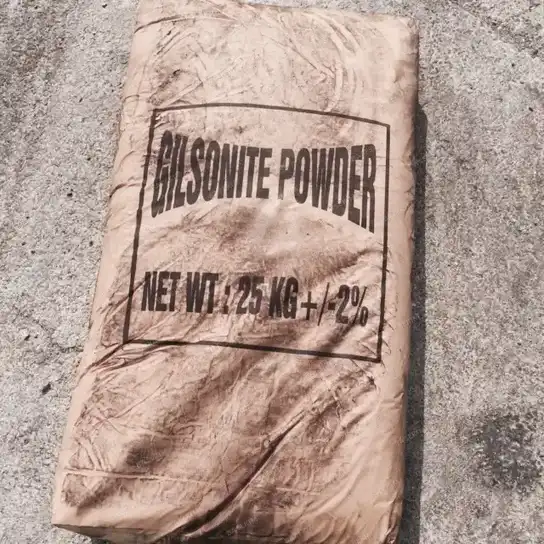
| Packing | 25 kg paper bags with PE liner, palletized. | |
Typical values. The final specification is confirmed in the COA of each shipment.
Related articles
Ink Grade Gilsonite Specifications Explained
Ink makers need tighter specifications than many other users. When writing a purchase specification, include: Make a standard…

Gilsonite in Specialty Inks and Toners
Beyond printing inks, gilsonite finds use in several specialty marking products. Deep black colour, good adhesion and solubility…

Gilsonite and Carbon Black Dispersion
Carbon black is difficult to disperse. Poor dispersion leads to low colour strength and unstable inks. Gilsonite helps.…